
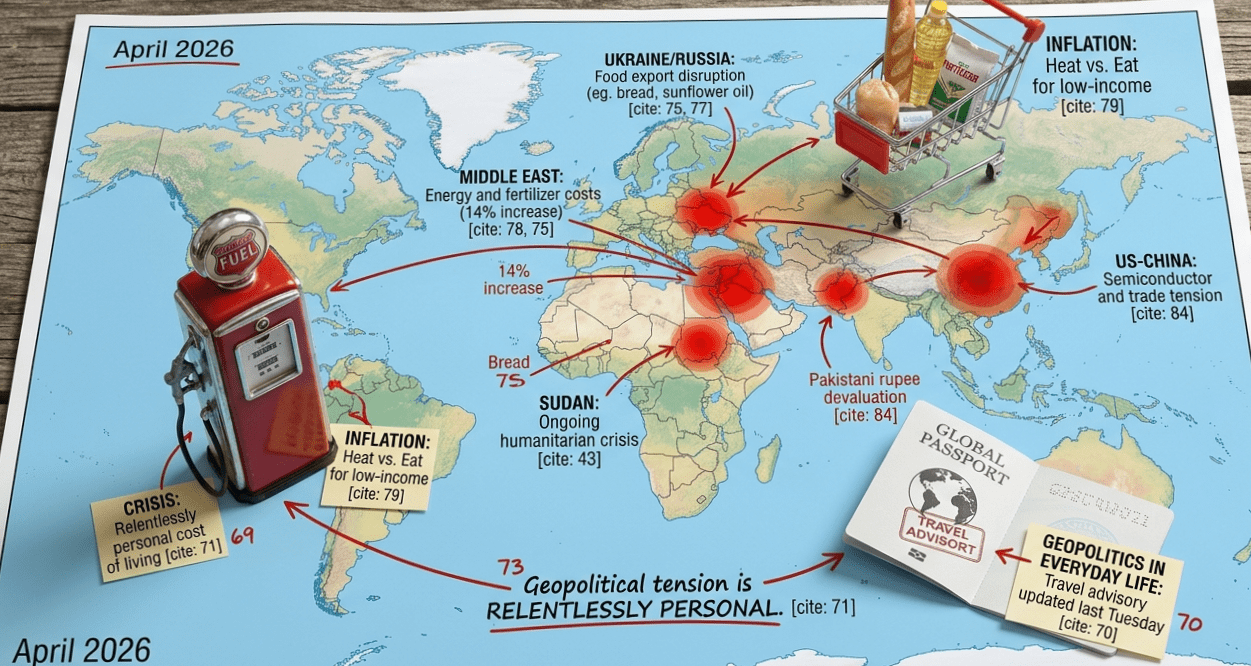
Most people think geopolitics lives in press briefings and summit rooms. It doesn’t. It lives in the price of your cooking oil, your mortgage rate, the job posting your company just pulled, and the travel advisory your government quietly updated last Tuesday. Geopolitical tension is not abstract. It is relentlessly personal.
What Does Geopolitical Tension Actually Mean for Ordinary People?
Geopolitical tension refers to conflict — economic, military, or diplomatic — between nations that disrupts the stability of global systems. For ordinary people, this translates into supply chain disruptions, currency fluctuations, energy price spikes, and migration pressure. When Russia invaded Ukraine in 2022, the ripple reached bread prices in Egypt, fertilizer costs in Pakistan, and sunflower oil availability in Nigeria — within weeks.
How Do Rising Tensions Affect the Cost of Living?
Conflict zones disrupt energy and food exports, which are foundational to global pricing. The World Bank’s 2025 Commodity Markets Outlook noted that countries dependent on imported energy experienced an average 14% increase in household energy bills during periods of heightened Middle East tension. For lower-income households, this is not a statistic — it is a choice between heating and eating.
Why Do Geopolitical Conflicts Drive Inflation in Peaceful Countries?
Modern economies are woven together through trade, currency markets, and shared financial systems. When a major economy imposes tariffs or sanctions, the entire global supply reprices. Investors respond to uncertainty by moving capital to safe-haven assets, strengthening the dollar but weakening emerging market currencies. In 2025, the Pakistani rupee lost 11% of its value during a single month of escalating US-China semiconductor tensions.
How Are Job Markets Changing Because of Global Instability?
Companies exposed to geopolitical risk are restructuring operations — relocating supply chains, reducing cross-border exposure, and building redundancy. The concept driving this is ‘friend-shoring’ — relocating manufacturing to politically allied nations. India, Mexico, and Vietnam have been primary beneficiaries since 2023. For workers, the lesson is uncomfortable: job security is now partly a geopolitical variable, not just a performance metric.
What Should Individuals Do to Protect Themselves Financially?
Diversifying savings across currencies and asset types, reducing reliance on single-source supply chains, and monitoring government trade advisories are practical starting points. Financial advisors increasingly include ‘geopolitical scenario planning’ as a standard service in 2026. Note: This is informational context, not financial advice — consult a qualified financial advisor for personal decisions.
FAQs
Q: How does geopolitical tension affect grocery prices?
A: Conflicts disrupt food and energy exports. Supply shortages and transport cost increases pass directly to consumers through higher grocery bills.
Q: Can one country’s conflict affect another country’s economy?
A: Yes. Global supply chains, currency markets, and trade agreements connect economies so tightly that a conflict anywhere can raise prices everywhere.
Q: What sectors are most vulnerable to geopolitical risk?
A: Energy, agriculture, semiconductors, and logistics are the most exposed sectors during periods of geopolitical tension.
Q: How can I stay financially resilient during global instability?
A: Diversify assets, reduce single-source dependencies, and follow commodity and currency trends with help from a qualified financial advisor.