
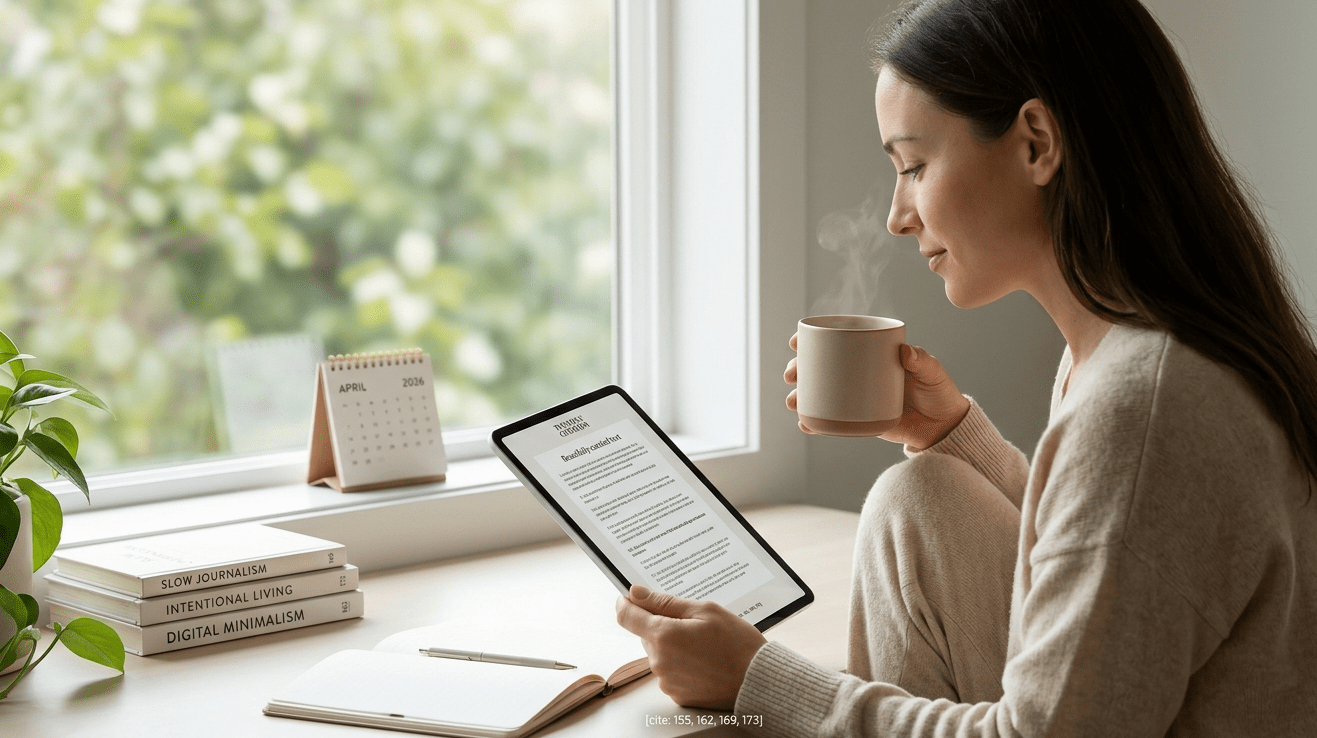
There is a version of staying informed that leaves you anxious, exhausted, and somehow less clear on what’s actually happening in the world. Most people know this feeling well. This is not a personal failure. It is a design problem — and it has a practical solution.
Why Does Following the News Feel So Exhausting in 2026?
News exhaustion affects nearly half of all news consumers globally. The Reuters Institute’s 2025 report found that 39% of people across 46 countries actively limit news consumption because of its negative emotional impact. The cause is not world events themselves — it is the delivery mechanism. Algorithmic feeds serve disproportionate amounts of conflict, crisis, and outrage, regardless of actual global prevalence.
What Is the Difference Between Being Informed and Being Saturated?
Being informed means you understand key events shaping your world and their implications. Being saturated means you’ve consumed large volumes of news content without gaining proportional understanding. Most daily news consumers in 2026 are saturated, not informed. They know something happened everywhere, but cannot explain why any of it matters for their decisions.
How Can You Build a Healthier News Consumption Routine?
The most effective approach used by journalists and informed professionals is intentional scheduling. Rather than checking news reactively throughout the day — which creates a constant cortisol drip — they allocate one or two fixed reading windows. Morning and early evening work best. Between those windows, notifications are off. This single habit reduces news-related anxiety more than any content filter or source change.
Which News Sources Are Worth Your Time in 2026?
Sources worth your time share three characteristics: they explain causes, not just events; they distinguish between confirmed facts and emerging reports; and they acknowledge uncertainty honestly. Strong categories include daily explainer newsletters, long-form weekly publications, and public broadcasting services structurally insulated from click incentives. Sources optimized primarily for emotional engagement are not worth regular consumption.
Is It Okay to Avoid the News Sometimes?
Not only is it okay — research suggests deliberate news breaks improve decision-making, emotional regulation, and attention span. A 2024 study in Health Communication found that participants who took a one-week news break reported significantly improved mood and only a marginal decrease in factual knowledge. The 24/7 stream is not a civic duty. It is a product designed to maximize your time on platform.
What Does a Sustainable News Diet Actually Look Like?
It looks like this: one curated newsletter each morning, one long-form piece three times a week, and a weekly summary of global events from a trusted source. That’s roughly 30–45 minutes of news per day — enough to remain genuinely informed, not enough to be overwhelmed. If a source consistently leaves you feeling helpless without providing actionable understanding, it is serving its own engagement metrics, not your informational needs.
FAQs
Q: How much time should I spend reading news each day?
A: Research suggests 30–45 minutes of intentional, scheduled news reading per day provides sufficient awareness without contributing to burnout.
Q: What is news fatigue and how is it caused?
A: News fatigue is psychological exhaustion caused by overconsumption of distressing news content, amplified by algorithmic feeds prioritizing emotional engagement.
Q: Are news breaks bad for staying informed?
A: No. Studies show deliberate news breaks improve emotional wellbeing with minimal loss of factual awareness. Critical events reach people through social and professional networks.
Q: What makes a news source worth following? A: A trustworthy source explains causes not just events, cites named sources, acknowledges uncertainty, and doesn’t rely primarily on emotional or alarming framing.
impressive Article.